60–65% Of your sellers’ week never touches a buyer.
Research, administration, and documentation eat the selling capacity you already pay for. Some of the costliest seats in the company spend most of their week not selling.
The new book from Doug Vinson
Revenue architecture first, then the AI leverage it can carry. The Field Manual is the build order.

Kindle edition, available now on Amazon.
Run your own numbers
For a decade, software companies bought growth by adding headcount. If CAC keeps rising while revenue per employee stays flat, you already know that trade has stopped working. Three numbers from Doug’s work inside PE and VC-backed software companies. Read them against your own team.
Research, administration, and documentation eat the selling capacity you already pay for. Some of the costliest seats in the company spend most of their week not selling.
The book calls this the clearest evidence of recoverable commercial capacity: selling time you can win back without a single new hire.
Volume metrics kept rising while the economics quietly failed. Activity without intelligence does not scale. It just gets more expensive.
“AI tools deployed into weak architecture produce productivity theater, not economic leverage.”
If you have already bought the tools and the number has not moved, this is why. The tools were never the problem.
The argument
AI is the leverage. Revenue architecture is the strategy. Human leadership is the difference.
So ask the question the book is built on: if you were designing your revenue system from scratch today, would you build what you currently have? For most companies above $30M ARR, the honest answer is no. The distance between what you have and what you would build is the book’s whole subject.
The mechanism
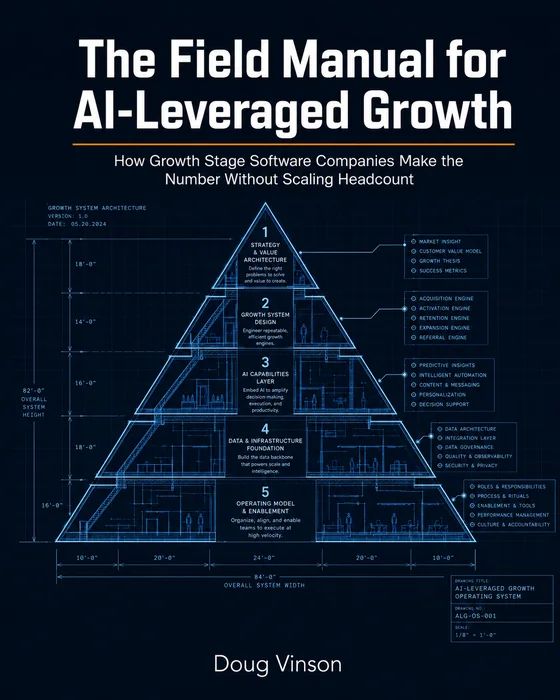
The Revenue Architecture Pyramid is the book’s spine: five layers, built bottom up, in order. AI amplifies architecture; it does not replace it. Skip a layer and the tools above it become expensive noise.
Not TAM. The market where urgency, differentiation, accessibility, and economics all hold, found with an AI-powered market intelligence system instead of a static slide.
Layer 1 of 5 · each layer depends on the one below itWhere growth actually comes from: the winnable market, the AI-powered ICP, economic segmentation, and the route-to-market decisions everything downstream depends on.
The engine rebuilt around signals: the AI-enabled SDR, outbound that lands inside the 24–48 hour high-intent window, and sellers who spend their week actually selling. Workflow by workflow, tools named.
What makes it stick: RevOps as the operating system, forecasts a board can trust because they are built on evidence, and the economics that turn adoption into enterprise value.
The team you hire next, and the one you do not: leverage-before-labor org design, the AI GTM flywheel, and a complete pre-LOI diligence framework for investors.
Built to be run, not just read:
What the system produces
Composite outcomes modeled in the book from anonymized client deployments, typically over three to four quarters. The author flags every figure as experience-based modeling, and shows the math.
Revenue per seller, same team
Seller time actually facing buyers
Forecast accuracy on committed deals
Qualified pipeline per SDR, per month
The book’s conservative estimate of incremental enterprise value from 12–18 months of disciplined implementation: $75M–$120M on an $80M–$100M ARR base.
Chapter 12 builds this model layer by layer, in language a CFO or PE sponsor can audit.The model, the assumptions behind it, and the sequence that produces it are the book.
Get the book on AmazonWho it’s for
Three seats, one shared problem: a growth plan that assumes leverage the current model cannot produce. Find yours.
CEOs and founders of $20M–$200M ARR software companies, and the CROs and CMOs who suspect the operating model, not the team, is the constraint.
RevOps leaders being handed AI tools inside organizations not yet designed to convert them into economic leverage.
PE operating partners, value-creation teams, CFOs, and board members who want to evaluate AI GTM with the rigor of any capital allocation decision.
Fair warning from the introduction: it is not an AI-trends overview, and it does not define CAC. It assumes you already operate at that level.
For PE firms & leadership teams
The fastest way to align a leadership team, or an entire portfolio, on AI-era GTM is to put the same field manual in everyone’s hands. Appendix A alone gives deal teams a complete GTM diligence framework: designed-vs-accumulated growth tests, an AI-theater diagnostic for CIM claims, and the questions to ask a CRO before the LOI.
Speaking
Doug speaks to boards, sales kickoffs, PE portfolio summits, and industry events, as an operator who has run these systems, not a futurist. Every talk is built from the book’s frameworks and lands on decisions, not trends.
Why AI accelerates whatever system it enters, and the architecture-first sequence that converts it into economic outcomes.
The economics of the AI-enabled GTM model: the four levers, the financial model, and what to show your board.
From “what are you doing with AI?” to “where has AI changed the math?” Preparing leadership for the next wave of board scrutiny.

Direct line
One form, straight to Doug. Tell him the room, the team, or the portfolio, and what number it has to make.
For everything else (board advisory, fractional GTM leadership, portfolio intervention), use the main contact page.
Questions
Kindle edition, available now on Amazon. Read it on any Kindle app or device.
That is the book’s exact starting point. Its central principle: AI cannot compensate for a weak architecture; it accelerates whatever system it enters. A well-designed architecture becomes more intelligent and faster-learning with AI; a poorly designed one becomes more expensively wrong, faster. The book is the sequence for building the architecture your tools are missing.
No, and it says so in the introduction. It is a field manual: eight 90-day implementation plans, 17+ tool profiles with human checkpoints, prompt templates, measurement frameworks, and board-presentation structures. Readers looking for an overview of AI trends “will find better options elsewhere.”
The book’s bet is the opposite: within 36 months, having AI tools will be meaningless as a differentiator. What compounds is architecture: the market focus, ICP, segmentation, and operating cadence the tools plug into. The author is vendor-neutral and has no commercial relationship with any tool named.
It assumes fluency. The introduction is explicit: it does not define CAC, NRR, or pipeline coverage. It is written for the people who already own commercial performance and need the redesign framework, not the vocabulary.
A dedicated audience bullet and an entire appendix. Appendix A is a pre-LOI GTM diligence framework: tests that separate designed growth from accumulated growth, an AI-theater diagnostic for CIM claims, five architectural failure patterns with valuation implications, and an interview guide for the CRO, CMO, RevOps leader, and CEO.
Chapter by chapter, as an operating sequence. Each major chapter ends with “Why This Helps Leadership Make the Number” and a 90-day plan with owners and day ranges, built to be run as a leadership team, not read alone. For team orders and portfolio programs, start a team inquiry.
The window
“The companies that understand this first will build the go-to-market model of the next decade. The companies that understand it second will spend the decade catching up.”
Within 36 months, the book argues, having AI will distinguish no one. The line is who rebuilt the architecture underneath it first. That is a decision, and it is open right now.
Get the book
The closing line of the book is also the way to read it: before the next tool purchase, before the next headcount request.
Also by Doug Vinson: Make the Damn Number · Ignite the Cybersecurity Growth Engine · Be Disciplined